

Vitamin D is an essential nutrient that helps the body absorb calcium and supports healthy bones, muscles, nerves, and normal immune function. The challenge is that vitamin D rich foods are relatively limited compared with foods that provide nutrients such as vitamin C or potassium. Fatty fish are among the best natural sources, while fortified foods provide an important source of vitamin D in many diets.
If you’re looking for practical vitamin D rich foods to include in your diet, this guide covers 20 options, including naturally occurring sources and commonly fortified foods.
Important: Vitamin D content can vary considerably between brands, preparation methods, serving sizes, and whether a food has been fortified. For packaged foods, always check the Nutrition Facts label.
Key Takeaways
- Fatty fish such as salmon, trout, tuna, and mackerel are among the best natural food sources of vitamin D.
- Very few foods naturally contain significant amounts of vitamin D.
- Fortified milk, plant-based beverages, cereals, orange juice, and some yogurts can provide vitamin D.
- Egg yolks, beef liver, cheese, and mushrooms contain smaller amounts.
- Some mushrooms can contain substantially more vitamin D when they have been exposed to ultraviolet light.
- Adults ages 19–70 generally need 15 mcg (600 IU) of vitamin D per day, while adults 71 and older need 20 mcg (800 IU).
- Food labels are especially important for fortified foods because vitamin D levels vary between products.
What Are Vitamin D Rich Foods?
Vitamin D rich foods are foods that provide meaningful amounts of vitamin D per serving. They fall into two main groups: natural sources and fortified foods.
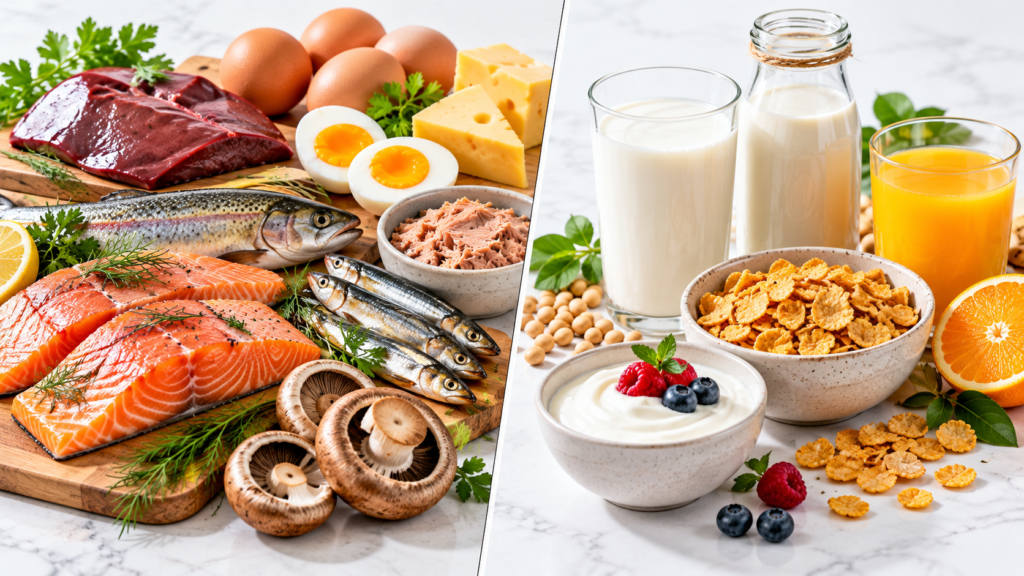
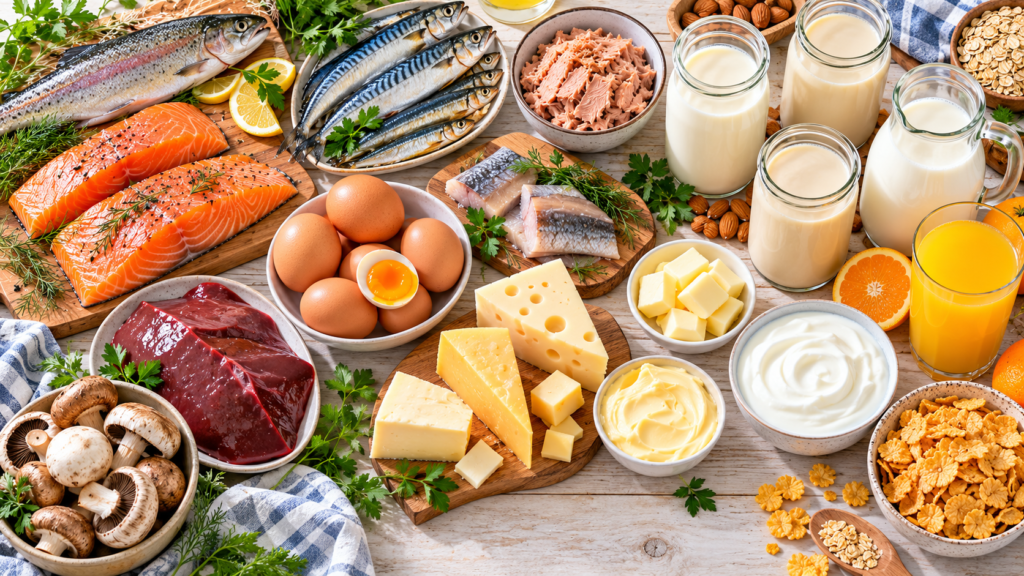
Natural food sources include fatty fish, egg yolks, beef liver, cheese, and certain mushrooms. Fortified foods have vitamin D added during processing. Examples include milk, some plant-based milk alternatives, breakfast cereals, orange juice, yogurt, and margarine.
According to the NIH Office of Dietary Supplements, very few foods naturally contain vitamin D. This is why food fortification can play an important role in helping people meet their vitamin D needs.
20 Vitamin D Rich Foods
The following list includes both naturally occurring sources and foods that commonly contain added vitamin D. Because fortified products can differ substantially by brand, use the amounts on the product label when available.
1. Salmon
Salmon is one of the most useful natural food sources of vitamin D. Different types and preparations can contain different amounts, but salmon consistently appears among the leading dietary sources of vitamin D.
It is also a source of protein and omega-3 fatty acids, making it an easy food to include in a nutrient-dense diet.
2. Rainbow Trout
Rainbow trout is another excellent natural source of vitamin D. USDA-derived nutrient tables cited by the U.S. Dietary Guidelines Advisory Committee list cooked rainbow trout among the foods with substantial vitamin D per standard serving.
Try baked or grilled trout with vegetables for a simple vitamin D-rich meal.
3. Swordfish
Swordfish contains vitamin D and is included among the fish with relatively high vitamin D content in USDA nutrient data.
Because swordfish can contain higher levels of mercury than some other fish, people who are pregnant, breastfeeding, or choosing fish for children should follow current fish-consumption guidance from relevant health authorities.
4. Canned Salmon
Canned salmon can be a convenient alternative to fresh fish. USDA nutrient data show that some canned salmon varieties provide substantial amounts of vitamin D per serving.
It can be used in salads, sandwiches, grain bowls, or simple salmon patties.
5. Mackerel
Mackerel is a fatty fish that naturally provides vitamin D. The NIH lists mackerel alongside salmon, trout, and tuna among important natural food sources.
Mackerel can be baked, grilled, or used in other fish-based meals.
6. Tuna
Tuna is another practical source of vitamin D, particularly when canned tuna is convenient for everyday meals.
If you eat tuna regularly, vary your seafood choices and follow current seafood safety recommendations.
7. Sardines
Sardines contain vitamin D and can also provide other nutrients, including calcium when the edible bones are included. USDA-derived data list canned sardines among vitamin D-containing foods.
They can be added to salads, toast, pasta, or grain-based meals.
8. Herring
Herring is another fatty fish that naturally provides vitamin D. The amount depends on the species and preparation, but it is a recognized dietary source of vitamin D.
9. Fortified Cow’s Milk
Milk is one of the most familiar examples of a food fortified with vitamin D. The NIH notes that almost all of the U.S. milk supply is fortified with approximately 3 mcg (120 IU) per cup, although products and countries can differ.
Always check the label rather than assuming every milk product contains the same amount.
10. Fortified Soy Milk
Many soy milk products are fortified with vitamin D. This can make fortified soy milk a useful option for people who do not drink cow’s milk.
The exact amount depends on the product, so check the Nutrition Facts label.
11. Fortified Almond Milk
Some almond milk products contain added vitamin D. However, fortification is not universal, and amounts vary between brands.
When shopping, look for vitamin D in the Nutrition Facts panel.
12. Fortified Oat Milk
Some oat milk products are fortified with vitamin D and other nutrients. As with other plant-based beverages, the nutritional profile depends on the brand and formulation.
This makes label checking particularly important when using fortified foods as regular vitamin D sources.
13. Fortified Breakfast Cereals
Many breakfast cereals are fortified with vitamins and minerals, including vitamin D. The amount can vary significantly between products.
A fortified cereal combined with fortified milk can be a convenient way to add vitamin D to breakfast.
14. Fortified Orange Juice
Some orange juice products are fortified with vitamin D. The NIH identifies fortified orange juice as one of the food products that may provide added vitamin D.
Check the label because not every orange juice product contains added vitamin D.
15. Fortified Yogurt
Some yogurts contain added vitamin D. However, unlike fortified milk, not every yogurt product is necessarily fortified, so the Nutrition Facts label is the best way to determine how much vitamin D a specific product provides.
For a nutrient-dense snack, pair yogurt with fruit, nuts, or seeds.
16. Egg Yolks
Egg yolks contain vitamin D naturally, although the amount is relatively small compared with fatty fish. USDA nutrient data show that a large egg provides a modest amount of vitamin D.
Eggs are easy to incorporate into breakfast, salads, sandwiches, and other meals.
17. UV-Exposed Mushrooms
Mushrooms are unusual because some can provide vitamin D, particularly mushrooms exposed to ultraviolet light. The NIH specifically notes that UV-exposed mushrooms can have increased vitamin D content.
This makes them an interesting food option for people looking for non-animal sources.
18. Beef Liver
Beef liver contains a small amount of vitamin D. It is not usually considered as concentrated a source as fatty fish, but it can contribute to overall dietary intake.
Because liver is also very high in vitamin A and other nutrients, it is generally best consumed in reasonable amounts rather than treated as an everyday staple.
19. Cheese
Some cheese contains vitamin D, although the amount is generally smaller and fortification varies. The NIH lists cheese among foods that contain small amounts of vitamin D.
Do not assume that every cheese is fortified with vitamin D. Check the product’s nutrition information.
20. Fortified Margarine
Some margarine products are fortified with vitamin D. The amount varies by product, so check the label before counting it as a significant vitamin D source.
Natural vs Fortified Vitamin D Foods
One of the most important things to understand about vitamin D rich foods is that not all food sources work in the same way.
Fatty fish such as salmon, trout, tuna, and mackerel naturally contain vitamin D. Egg yolks, beef liver, cheese, and mushrooms also contain vitamin D, although generally in smaller amounts.
Fortified foods are different. Manufacturers add vitamin D to products such as milk, some plant-based beverages, breakfast cereals, orange juice, yogurt, and margarine. The amount can vary substantially from one product to another.
This is why reading the Nutrition Facts label is essential when choosing fortified foods.
[Internal Link: Insert relevant internal URL here with anchor text: Vitamin D Foods Chart]
For example, you could link this section to your upcoming Bloomivita article “Vitamin D Foods Chart: Easy Guide to Dietary Sources.”
How Much Vitamin D Do You Need?
Vitamin D requirements depend on age.
According to the NIH Office of Dietary Supplements, the recommended daily amount is:
| Age group | Recommended vitamin D |
|---|---|
| Birth to 12 months | 10 mcg (400 IU) |
| Children 1–13 years | 15 mcg (600 IU) |
| Teens 14–18 years | 15 mcg (600 IU) |
| Adults 19–70 years | 15 mcg (600 IU) |
| Adults 71+ years | 20 mcg (800 IU) |
| Pregnant and breastfeeding teens and women | 15 mcg (600 IU) |
These values include vitamin D obtained from food, beverages, and supplements.
For a more detailed explanation:
[Internal Link: Insert relevant internal URL here with anchor text: How Much Vitamin D Do You Need Per Day?]
Can You Get Enough Vitamin D From Food Alone?
For some people, getting enough vitamin D from food alone can be difficult because relatively few foods naturally contain significant amounts of the nutrient. Fortified foods can help increase dietary intake.
Vitamin D can also be produced by the body when bare skin is exposed to sunlight. However, the amount produced varies according to factors such as age, skin pigmentation, location, season, clothing, sunscreen use, and other factors. Sunlight through a window does not provide the same vitamin D-producing exposure because UVB radiation is filtered by glass.
Therefore, it is better to think about vitamin D intake as part of an overall nutrition and health strategy rather than relying on a single food.
Are Vitamin D Supplements Necessary?
Not everyone needs a vitamin D supplement.
The NIH recommends getting most nutrients from foods and beverages when possible, while recognizing that fortified foods and supplements can be useful in certain situations.
Whether supplementation is appropriate depends on factors such as diet, sun exposure, age, health conditions, medications, and vitamin D status.
If you are concerned about deficiency or considering a high-dose supplement, discuss your situation with a qualified healthcare professional.
[External Link: Insert high-authority external URL here with anchor text: NIH Vitamin D Fact Sheet]
For Bloomivita, this should link to the NIH Office of Dietary Supplements Vitamin D Fact Sheet, which provides evidence-based information about vitamin D, food sources, recommended amounts, deficiency, safety, and interactions.
What to Look for on Food Labels
When buying fortified foods, don’t rely solely on the product name.
Look for:
- Vitamin D listed in the Nutrition Facts panel
- The amount per serving
- Serving size
- Whether the product is fortified
- The percentage of Daily Value
- Differences between similar brands
This is particularly important for plant-based milk, cereals, yogurt, orange juice, and other fortified products because vitamin D levels can vary.
The USDA’s FoodData Central database is another useful resource for checking nutrient information for individual foods.
Simple Ways to Add Vitamin D Rich Foods to Your Diet
You don’t need to completely change your diet to include more vitamin D sources.
Try simple combinations such as:
Breakfast: fortified milk or fortified plant milk with vitamin D-fortified cereal and eggs.
Lunch: tuna or salmon salad with vegetables.
Dinner: grilled salmon or trout with vegetables and a whole-grain side.
Snack: fortified yogurt with fruit.
Plant-based option: UV-exposed mushrooms combined with fortified plant-based milk or another fortified food.
The goal is variety rather than depending on one food every day.
A Note About Vitamin D Supplements
Food is generally the preferred way to obtain nutrients, but supplements can be useful when dietary intake is insufficient or when a healthcare professional recommends them.
More is not necessarily better. For adults, the established upper limit for vitamin D intake from all sources is 100 mcg (4,000 IU) per day unless a healthcare professional recommends otherwise for a specific medical reason. Excessive vitamin D, particularly from supplements, can cause toxicity and lead to problems such as high calcium levels and kidney complications.
If you take medications, remember that vitamin D supplements can interact with some medicines, including certain statins, steroids, orlistat, and thiazide diuretics.

Frequently Asked Questions
What are the best vitamin D rich foods?
Fatty fish such as salmon, trout, tuna, mackerel, and sardines are among the best natural food sources of vitamin D. Fortified milk and other fortified foods can also provide significant amounts depending on the product.
Which foods are high in vitamin D naturally?
Fatty fish are among the strongest natural sources. Egg yolks, beef liver, cheese, and some mushrooms also contain vitamin D, although generally in smaller amounts.
Are there vitamin D rich fruits?
Most fruits are not naturally rich sources of vitamin D. Some fruit products, such as certain orange juices, may contain vitamin D when they have been fortified. Always check the label.
Are there vitamin D rich vegetables?
Most vegetables are not naturally significant sources of vitamin D. Mushrooms are an important exception, particularly varieties that have been exposed to ultraviolet light.
What foods are high in vitamin D for vegetarians?
Depending on the person’s dietary pattern, fortified milk or plant-based beverages, fortified cereals, fortified orange juice, fortified yogurt, UV-exposed mushrooms, and eggs can provide vitamin D. Exact amounts vary by product.
Can I get enough vitamin D from food?
It can be difficult for some people because relatively few foods naturally contain substantial vitamin D. Fatty fish and fortified foods can make an important contribution, but individual needs vary.
How much vitamin D do adults need each day?
Adults ages 19–70 generally need 15 mcg (600 IU) per day, while adults 71 and older need 20 mcg (800 IU), according to the NIH.
Conclusion
Adding vitamin D rich foods to a balanced diet can help increase dietary vitamin D intake. Fatty fish such as salmon, trout, tuna, mackerel, and sardines are among the most useful natural sources, while fortified milk, plant-based beverages, cereals, orange juice, and some yogurts can provide additional vitamin D.
The most practical approach is variety. Choose foods you enjoy, check labels on fortified products, and avoid assuming that every product within a food category contains the same amount of vitamin D.
If you are concerned about vitamin D deficiency or considering supplementation, a healthcare professional can help determine whether testing or supplementation is appropriate for you.
Medical disclaimer: This article is for general educational purposes and does not replace individualized medical advice, diagnosis, or treatment.