
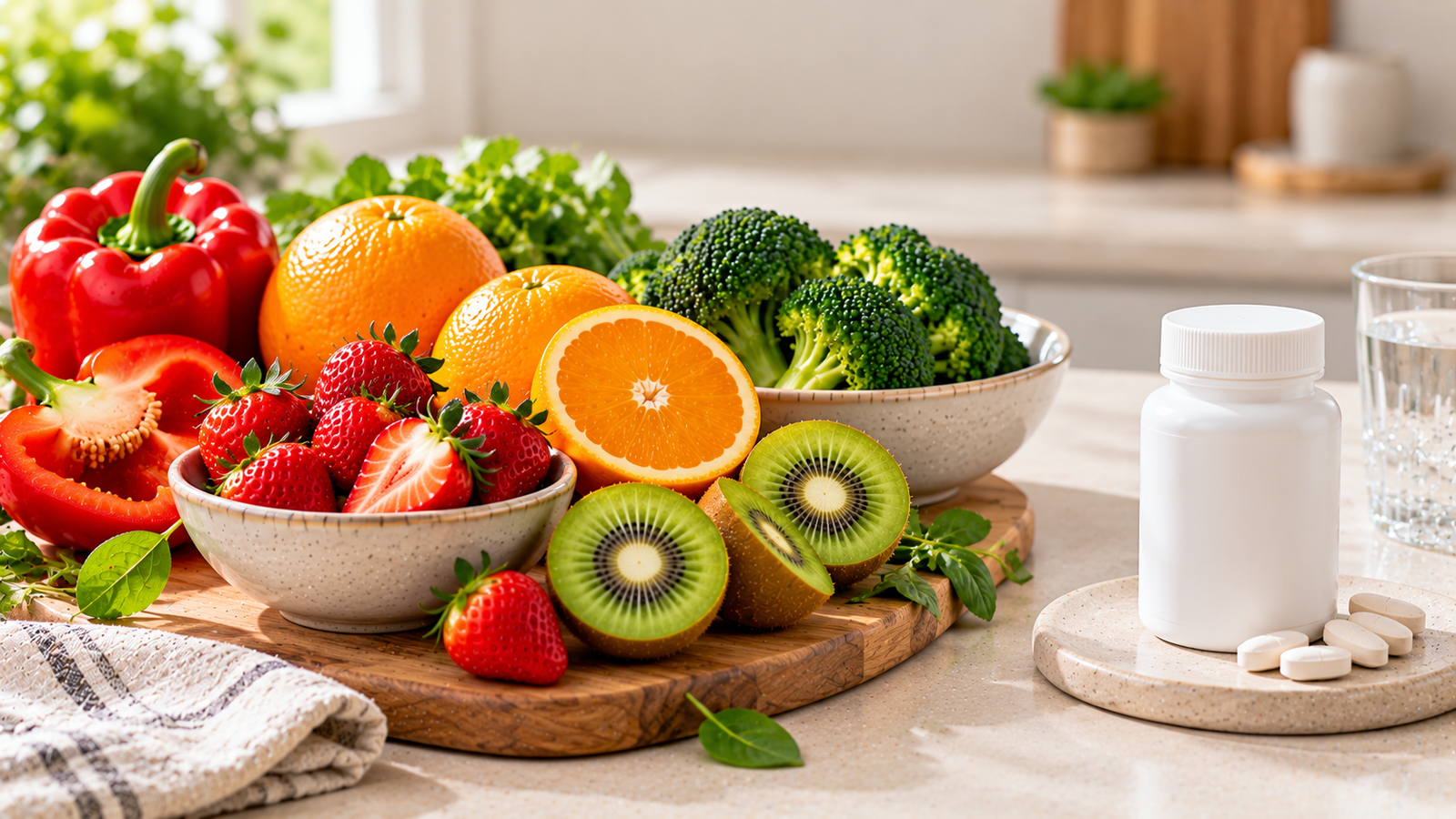
When comparing vitamin C supplements vs food, the best choice depends on your diet, nutritional needs, and health circumstances. Fruits and vegetables provide vitamin C alongside fiber and other beneficial nutrients, while supplements offer a convenient, measured amount when dietary intake is insufficient or additional vitamin C is recommended.
Vitamin C, also known as ascorbic acid, is an essential water-soluble vitamin. Your body needs it to produce collagen, support normal immune function, and improve the absorption of iron from plant-based foods. Because the body cannot make vitamin C on its own, you must obtain it from your diet or, when appropriate, supplements.
But does taking a vitamin C tablet provide the same benefits as eating an orange? Are supplements necessary if you already eat fruit and vegetables? And how much vitamin C do you actually need?
This guide compares both options, explains their advantages and limitations, and offers practical advice for making an informed choice.
Key Takeaways
- Fruits and vegetables are excellent first-choice sources of vitamin C for most people.
- Vitamin C in supplements can be absorbed similarly to vitamin C in foods when comparing common forms of ascorbic acid.
- Foods provide additional nutrients and dietary fiber that a vitamin C tablet does not.
- Supplements may be useful when dietary intake is inadequate or a healthcare professional recommends them.
- High doses of vitamin C supplements can cause digestive side effects and may be unsuitable for some people.
- Most adults need 75–90 mg of vitamin C daily, with different recommendations for pregnancy, breastfeeding, and smoking.
- More vitamin C is not automatically better, and supplements should not replace a balanced diet.
Vitamin C Supplements vs Food: What Is the Difference?
The main difference is how you obtain vitamin C and what else comes with it.
Food sources deliver vitamin C as part of a broader nutritional package. Supplements deliver a concentrated amount in a tablet, capsule, powder, or liquid.
Vitamin C From Food
Natural food sources include oranges, kiwi, strawberries, guava, bell peppers, broccoli, Brussels sprouts, tomatoes, and other fruits and vegetables.
These foods also provide varying amounts of fiber, minerals, water, and other plant compounds. Their overall nutritional contribution depends on the specific food and serving size.
Examples include:
- One medium orange for a convenient fruit snack.
- Sliced kiwi or strawberries with breakfast.
- Red bell peppers added to a salad or sandwich.
- Broccoli served with lunch or dinner.
- Tomatoes and vegetables added to soups, curries, or grain bowls.
For many people, including a variety of these foods in everyday meals is a practical way to meet vitamin C requirements.
Vitamin C From Supplements
Vitamin C supplements commonly contain ascorbic acid. Other forms include sodium ascorbate, calcium ascorbate, and combination products containing vitamin C with other ingredients.
Supplements can provide a predictable amount per serving, which may be helpful for people who struggle to meet their needs through food.
However, taking a supplement does not automatically improve health if you already consume enough vitamin C. The appropriate choice depends on your intake and circumstances.
The NIH Office of Dietary Supplements reports that the bioavailability of common supplemental ascorbic acid is comparable to that of ascorbic acid naturally present in foods. This means it would be inaccurate to claim that vitamin C from food is always absorbed better than vitamin C from supplements. <Cite refs={[“turn451046search2”]} />
Vitamin C Supplements vs Food: Quick Comparison
| Feature | Vitamin C from food | Vitamin C supplements |
|---|---|---|
| Provides vitamin C | Yes | Yes |
| Provides dietary fiber | Many whole-food sources do | No, unless included in a separate ingredient |
| Provides other nutrients | Often, depending on the food | Depends on the formula |
| Measured dose | Varies by portion and food | Usually stated per serving |
| Convenience | Requires choosing and preparing food | Portable and easy to measure |
| May help address low intake | Yes | May help when appropriate |
| Risk of excessive intake | Unlikely from ordinary foods alone | More relevant with high-dose products |
| Replaces a varied diet | No | No |
Bottom line: Food is a practical starting point for meeting nutritional needs. Supplements can serve a useful purpose when there is a reason to take them, but they are not a universal requirement.

Vitamin C supplements vs food, comparing fresh fruit and vegetables with an unbranded vitamin C supplement.
Best Food Sources of Vitamin C
If you want to increase your vitamin C intake naturally, begin with foods you already enjoy. You do not need to eat every item on the list; choose a variety that suits your budget, preferences, and meal routine.
Vitamin C Foods Chart
The following values are approximate and based on common serving sizes listed by the NIH Office of Dietary Supplements. Actual amounts vary with food variety, storage, and preparation. <Cite refs={[“turn451046search0″,”turn451046search2”]} />
| Food | Typical serving | Approx. vitamin C |
|---|---|---|
| Red sweet bell pepper, raw | ½ cup | 95 mg |
| Orange juice | ¾ cup | 93 mg |
| Orange | 1 medium | 70 mg |
| Kiwi | 1 medium | 64 mg |
| Green sweet bell pepper, raw | ½ cup | 60 mg |
| Broccoli, cooked | ½ cup | 51 mg |
| Strawberries, sliced | ½ cup | 49 mg |
| Brussels sprouts, cooked | ½ cup | 48 mg |
| Grapefruit | ½ medium | 39 mg |
| Broccoli, raw | ½ cup | 39 mg |
| Cantaloupe | ½ cup | 29 mg |
| Cauliflower, raw | ½ cup | 26 mg |
| Tomato, raw | 1 medium | 17 mg |
| Potato, baked | 1 medium | 17 mg |
These values are estimates, not exact amounts for every individual food. The portions differ, so compare the specified serving sizes rather than assuming the values are per 100 grams.
1. Oranges and Citrus Fruits
Oranges are familiar, portable sources of vitamin C. One medium orange provides approximately 70 mg.
Other citrus fruits, including grapefruit, can also contribute to your daily intake. Whole fruit provides fiber, while juice can provide a concentrated serving of vitamin C without the same fiber content.
Practical tip: Keep whole fruit available for breakfast or snacks, and choose portions that fit your appetite.
2. Kiwi and Strawberries
Kiwi and strawberries are convenient alternatives to citrus fruits. They work well in breakfast bowls, fruit salads, and smoothies.
Add sliced kiwi to oatmeal or combine strawberries with plain yogurt for a simple snack.
3. Bell Peppers
Red and green bell peppers are especially useful vegetable sources of vitamin C. Add raw strips to salads, sandwiches, wraps, or vegetable platters.
Eating some peppers raw is also an easy way to avoid losses that can occur during prolonged cooking.
4. Broccoli and Brussels Sprouts
Broccoli and Brussels sprouts provide vitamin C along with fiber and other nutrients. They are easy to include in balanced lunches and dinners.
Steam them until just tender, or cook them briefly as part of a vegetable dish.
5. Tomatoes, Cabbage, and Other Vegetables
Tomatoes, cabbage, cauliflower, and potatoes can also contribute to vitamin C intake. Although their amounts vary, small contributions from several foods can add up throughout the day.
For more examples, see our [Internal Link: Insert relevant internal URL here with anchor text — Vitamin C Foods Chart: Daily Sources at a Glance].
How Much Vitamin C Do You Need Every Day?
Vitamin C requirements vary according to age, sex, and life stage. The following recommended daily amounts are based on the US National Institutes of Health guidance. Recommendations may differ between national health authorities.
| Life stage | Recommended amount per day |
|---|---|
| Children aged 1–3 | 15 mg |
| Children aged 4–8 | 25 mg |
| Children aged 9–13 | 45 mg |
| Teen boys aged 14–18 | 75 mg |
| Teen girls aged 14–18 | 65 mg |
| Adult men aged 19 and older | 90 mg |
| Adult women aged 19 and older | 75 mg |
| Pregnant teens | 80 mg |
| Pregnant adults | 85 mg |
| Breastfeeding teens | 115 mg |
| Breastfeeding adults | 120 mg |
People who smoke should add 35 mg to the recommendation for their age and life stage. <Cite refs={[“turn451046search0″,”turn451046search2”]} />
Can Food Alone Meet Your Daily Vitamin C Needs?
Many people can meet their vitamin C needs through a varied diet.
For example, a medium orange provides about 70 mg, and half a cup of raw red bell pepper provides approximately 95 mg. These are useful contributions toward the standard adult recommendation.
However, the goal is not to rely on one food. Combining different fruits and vegetables helps provide a broader range of nutrients and makes your diet easier to maintain.
How Can You Tell Whether Your Intake Is Enough?
Start by reviewing your usual eating pattern:
- Do you regularly eat fruits or vegetables?
- Do your meals include a variety of produce?
- Do you have dietary restrictions that limit vitamin C sources?
- Have you been told by a healthcare professional that your intake may be inadequate?
A food diary can help you understand your habits. If you suspect a deficiency or have a condition that affects nutrient absorption, consult a healthcare professional rather than relying on symptoms or supplements alone.
When Might Vitamin C Supplements Be Useful?
Vitamin C supplements may be appropriate when someone cannot reliably obtain enough vitamin C from food or has a specific clinical reason for supplementation.
The need depends on individual circumstances rather than the popularity of a particular product.
1. When Your Diet Is Very Limited
People who eat a very restricted range of foods may struggle to obtain sufficient vitamin C. This can happen because of dietary limitations, food access issues, severe food aversions, or other circumstances.
Improving dietary variety is useful when possible. A healthcare professional can help determine whether a supplement is also appropriate.
2. When a Healthcare Professional Recommends Supplementation
A clinician may recommend vitamin C based on dietary intake, a medical condition, or an identified nutritional concern.
Follow the recommended dose and duration instead of assuming that a high-dose product is more effective.
3. When Medical Conditions Affect Nutritional Needs
Certain conditions can affect vitamin C intake, absorption, or requirements. People receiving treatment for complex medical conditions may need individualized advice.
If you have a chronic illness, significant digestive problems, or a medically restricted diet, ask your clinician or registered dietitian whether you need a supplement.
4. During Specific Life Stages or Dietary Circumstances
Pregnancy, breastfeeding, and some restricted diets can change nutritional requirements. A supplement may be suitable in some situations, but the right choice depends on the full dietary and medical context.
Do not start a high-dose vitamin C product during pregnancy or breastfeeding without checking whether it is appropriate for you.
What Are the Benefits of Getting Vitamin C From Food?
Food offers more than vitamin C alone. It supplies a combination of nutrients that can support an overall healthy eating pattern.
You Get Fiber and Other Nutrients
Whole fruits and vegetables can provide fiber, potassium, folate, and other nutrients, depending on the food. A vitamin C tablet does not provide these benefits unless additional ingredients are included.
Food Encourages Dietary Variety
Choosing different colors and types of produce helps diversify your diet. Oranges, kiwi, strawberries, peppers, broccoli, and tomatoes each contribute different nutritional characteristics.
Food Can Fit Into Everyday Meals
You can add fruit to breakfast, include vegetables in lunch, or serve broccoli with dinner without needing a separate supplement routine.
Food Supports More Than One Nutritional Goal
Pairing vitamin C-rich vegetables with beans or lentils can improve the absorption of non-heme iron from plant foods.
For example, add bell peppers or tomatoes to a lentil salad or serve fruit with a meal containing chickpeas.
Vitamin C and Iron: Foods That Help You Get More Iron

Everyday meals featuring natural vitamin C foods such as kiwi, strawberries, oranges, bell peppers, tomatoes, and broccoli.
Are Vitamin C Supplements Absorbed Better Than Food?
Neither food nor supplements should be described as universally superior in absorption.
According to the NIH Office of Dietary Supplements, common supplemental ascorbic acid has bioavailability comparable to ascorbic acid naturally present in foods. The amount absorbed also depends on the dose: the proportion absorbed decreases as vitamin C intake becomes very high. <Cite refs={[“turn451046search2”]} />
This means that taking a larger dose does not necessarily mean your body will use proportionally more vitamin C.
Is Natural Vitamin C Chemically Different?
Vitamin C from food and common supplements can supply the same essential nutrient: ascorbic acid. However, foods also contain other compounds that contribute to their overall nutritional value.
Some supplements include bioflavonoids or other ingredients, but there is not strong evidence that every specialized vitamin C formula is superior to standard ascorbic acid.
Does a Higher Dose Work Better?
Not necessarily. Vitamin C is water-soluble, and the body regulates its levels. At high intakes, the proportion absorbed decreases, and excess absorbed vitamin C is largely eliminated in urine.
The practical goal is to meet your needs, not to take the highest available dose.
What Are the Risks of Vitamin C Supplements?
Vitamin C is an essential nutrient, but supplements can cause side effects, particularly at high doses.
Common Side Effects
High supplemental intake may cause:
- Diarrhea
- Nausea
- Abdominal cramps
- Other digestive discomfort
Reducing an unnecessarily high dose or stopping a nonessential supplement may resolve these effects, but seek medical advice if symptoms persist or are severe.
Kidney Stones and Other Medical Considerations
High vitamin C intake may be a concern for some people, including those with certain kidney conditions or a history of kidney stones. Evidence and individual risks vary, so ask a healthcare professional before taking high doses.
People with hereditary hemochromatosis, a condition involving excessive iron accumulation, should also seek medical advice because high vitamin C intake can worsen iron overload.
Medication Interactions
Vitamin C supplements may interact with certain medicines or medical treatments. If you receive chemotherapy or radiation therapy, speak with your oncology team before taking vitamin C supplements, especially at high doses.
Tell your doctor or pharmacist about any supplement you take, including its dose and ingredients.
What Is the Upper Limit for Adults?
For adults, the US tolerable upper intake level for vitamin C is 2,000 mg per day from all sources. This is a safety limit, not a recommended daily target. Lower upper limits apply to children and teenagers. <Cite refs={[“turn451046search0″,”turn451046search2”]} />
Ordinary food intake is generally not the source of excessive vitamin C consumption. High-dose supplements are more likely to push total intake toward or above the upper limit.
How to Choose a Vitamin C Supplement
If a supplement is appropriate for you, focus on the dose, ingredients, quality, and your reason for taking it.
Check the Amount Per Serving
Look at the vitamin C amount per tablet, capsule, or measured scoop. Some products contain far more than the recommended daily intake.
A high amount is not automatically a better choice.
Review the Ingredients
Vitamin C supplements may contain ascorbic acid, mineral ascorbates, or combinations with other nutrients. Check for added ingredients that may be unsuitable for you.
Avoid Unsupported Health Claims
Be cautious of products promising to prevent illness, dramatically boost immunity, reverse aging, or deliver guaranteed results.
Vitamin C is important for normal body function, but a supplement cannot replace a balanced diet or appropriate medical care.
Consider Product Quality
Choose products from reputable manufacturers and look for credible independent quality testing where available. Quality seals may help assess manufacturing and product verification, but they do not guarantee that a supplement is effective for your specific needs.
Ask for Advice if You Have Health Conditions
If you take prescription medicines, have kidney problems, have a condition affecting iron levels, or are undergoing cancer treatment, check with your healthcare professional before using high-dose vitamin C.

Comparing vitamin C-rich foods with an unbranded vitamin C supplement on a clean kitchen counter.
A Practical Food-First Plan for Daily Vitamin C
If you want to improve your intake, begin with simple meals rather than buying supplements immediately.
Breakfast
Choose one of these ideas:
- Oatmeal topped with kiwi or strawberries.
- An orange alongside your usual breakfast.
- Eggs with sliced bell peppers and tomatoes.
Lunch
Try:
- A chickpea salad with tomatoes and peppers.
- A sandwich with fresh vegetables.
- A lentil dish served with a vitamin C-rich vegetable.
Dinner
Consider:
- Steamed broccoli with fish, chicken, tofu, or beans.
- A vegetable curry with tomatoes and cauliflower.
- Roasted Brussels sprouts served with grains and a protein source.
Snacks
Easy options include:
- One orange or kiwi.
- Strawberries.
- Sliced bell peppers with hummus.
- A small bowl of mixed fruit.
How to Preserve Vitamin C in Foods
Vitamin C can be reduced by prolonged storage and some cooking methods. To help limit losses:
- Store perishable produce appropriately.
- Wash produce before cutting it.
- Avoid unnecessarily long cooking times.
- Steam vegetables or use other suitable methods that require little water.
- Eat a mix of raw and cooked fruits and vegetables.
These steps can help you make the most of your food without needing to avoid cooking altogether.
Frequently Asked Questions
Is vitamin C from food better than supplements?
Food is a good first choice for most people because it provides vitamin C along with fiber and other nutrients. However, common supplemental ascorbic acid can be absorbed similarly to vitamin C from food. Supplements may be useful when there is a specific need.
Should I take vitamin C supplements every day?
Not everyone needs a daily supplement. If you regularly eat a varied diet with fruits and vegetables, you may already meet your needs. Consider your dietary intake and ask a healthcare professional if you have concerns about deficiency or supplementation.
What is the best natural source of vitamin C?
Red bell peppers, oranges, kiwi, strawberries, broccoli, and Brussels sprouts are excellent options. The best choice for you depends on portion size, availability, cost, and personal preference.
Can vitamin C supplements prevent colds?
Regular supplementation does not appear to prevent the common cold for most people, although it may slightly shorten the duration or reduce the severity of colds in some circumstances. Starting vitamin C after symptoms begin has not consistently shown a benefit. Vitamin C should not be treated as a cure for colds. <Cite refs={[“turn451046search0”]} />
Is 1,000 mg of vitamin C too much?
A 1,000 mg supplement is much higher than the recommended daily intake for most adults. It is below the US adult upper limit of 2,000 mg per day, but that does not mean everyone should take it. High doses can cause digestive side effects and may be unsuitable for some people.
Can I get enough vitamin C without supplements?
Many people can meet their daily requirements through fruits and vegetables. Oranges, kiwi, strawberries, peppers, and broccoli are useful options. People with restricted diets or certain medical conditions may need individualized advice.
Is natural vitamin C safer than supplemental vitamin C?
Normal amounts from food are generally safe for most people. Supplements can also be safe when appropriately used, but high doses may cause side effects and create concerns for people with certain conditions or medication regimens.
Can I take vitamin C supplements with other vitamins?
It depends on the products, doses, medicines, and your health circumstances. Check the ingredients of multivitamins and other supplements to avoid unintentionally taking excessive amounts, and ask a pharmacist or healthcare professional if you are unsure.
Conclusion: Vitamin C Supplements vs Food — Which Should You Choose?
When comparing vitamin C supplements vs food, a food-first approach is a practical choice for most people. Fruits and vegetables provide vitamin C alongside fiber and other nutrients, and a varied diet can meet the needs of many adults.
Supplements can still be useful when food intake is inadequate, a healthcare professional recommends them, or individual circumstances make it difficult to meet nutritional requirements. The key is to choose an appropriate dose rather than assuming that more vitamin C delivers greater benefits.
Start by reviewing your usual meals and adding foods such as oranges, kiwi, strawberries, bell peppers, and broccoli. If you suspect a deficiency or have a medical condition that affects your nutritional needs, seek professional advice before starting high-dose supplements.
The best choice is the one that helps you meet your actual needs safely and consistently.
1 thought on “Vitamin C Supplements vs Food: What Should You Know?”