Vitamin B12 is an essential nutrient that supports normal nerve function, red blood cell formation, and DNA production. Your body needs a regular supply, but there is often confusion about the best way to get it: through food, fortified products, or supplements.
Understanding vitamin B12 from food vs supplements can help you make choices that fit your diet, lifestyle, and nutritional needs. Foods such as fish, meat, eggs, milk, and yogurt provide vitamin B12 naturally. Fortified cereals and certain plant-based milk alternatives can also supply it. Supplements offer another way to obtain B12, particularly for people who do not regularly eat animal-derived foods or who have difficulty absorbing the nutrient.
Neither approach is automatically best for everyone. Many people can obtain enough vitamin B12 through a varied diet, while others may need fortified foods or supplements to maintain adequate intake. People with certain medical conditions may require specific treatment rather than dietary changes alone.
This guide explains the differences between vitamin B12 foods and supplements, how absorption works, which sources are most useful, and how to decide what may be appropriate for you.
Key Takeaways
- Vitamin B12 occurs naturally in animal-derived foods and is added to certain fortified foods.
- Supplements provide a concentrated, convenient source of B12 and can be particularly important for vegans and people with absorption problems.
- Your body processes vitamin B12 from food and supplements through related but not identical absorption pathways.
- Most adults need 2.4 micrograms (mcg) of vitamin B12 daily under US dietary recommendations.
- High-dose supplements are not automatically better for people who already have adequate B12 levels.
- A confirmed deficiency may require medical treatment, sometimes with high-dose oral supplements or injections.
- Your diet, age, medications, health conditions, and ability to absorb B12 all affect which approach is most suitable.
What Is Vitamin B12, and Why Does Your Body Need It?
Vitamin B12, also known as cobalamin, is a water-soluble vitamin involved in several essential processes. Your body cannot make enough of it independently, so you must obtain it from food, fortified products, or supplements.
1. It supports normal red blood cell formation
Vitamin B12 helps your body produce healthy red blood cells. When B12 levels become too low, red blood cell production can be disrupted, potentially leading to megaloblastic anemia.
This type of anemia can cause fatigue, weakness, pale skin, and shortness of breath.
2. It helps maintain normal nerve function
Vitamin B12 is important for maintaining the nervous system. Prolonged deficiency can cause numbness, tingling, balance difficulties, and other neurological symptoms.
Some nerve-related effects may become permanent if a deficiency is left untreated, which is why early assessment matters.
3. It is needed for DNA production
Your body uses vitamin B12 in reactions involved in DNA synthesis. This process is essential for normal cell growth and function.
4. It participates in energy metabolism
Vitamin B12 helps the body process certain nutrients. However, it is not a stimulant, and taking additional B12 does not generally increase energy in people who already have sufficient levels.
Getting enough B12 is important, but more is not always better.
Vitamin B12 Consumer Fact Sheet
Vitamin B12 From Food vs Supplements: What Is the Difference?
The main difference is how you obtain the nutrient and how each option fits into your overall nutritional needs.
Food provides vitamin B12 alongside other nutrients, while supplements deliver a measured amount of the vitamin in a concentrated form.
| Feature | Vitamin B12 from food | Vitamin B12 from supplements |
|---|---|---|
| Main sources | Meat, fish, eggs, milk, yogurt, and some cheeses | Tablets, capsules, liquids, dissolvable products, and some other formulations |
| Other nutrients | Often provides protein, minerals, or other vitamins | Usually focuses on B12, although some products combine nutrients |
| Convenience | Requires suitable foods and meal planning | Convenient for people who need a reliable additional source |
| Suitable for vegans | Only if the food is fortified with B12 | Vegan-friendly products are available |
| Absorption | Requires digestive processing, including intrinsic factor for normal absorption of most food-bound B12 | High doses can allow a small amount to be absorbed independently of intrinsic factor |
| Typical dose | Varies by food and serving size | Varies by product and formulation |
| Best use | Meeting everyday nutritional needs through meals | Filling dietary gaps or treating deficiency when medically appropriate |
Important: Fortified foods sit between these categories. They are foods that contain added vitamin B12, so they can be useful for people who avoid animal products.
The right approach depends on whether your current diet provides enough B12, whether you can absorb it effectively, and whether you have an identified deficiency.
Best Natural Food Sources of Vitamin B12
For people who eat animal-derived foods, several familiar ingredients can provide vitamin B12 as part of a balanced diet.
1. Fish and seafood
Fish and seafood are among the richest food sources of vitamin B12.
Examples include:
- Clams and certain other shellfish
- Salmon
- Trout
- Sardines
- Tuna
- Other fish and seafood varieties
The amount of B12 varies by species, serving size, and preparation. Some shellfish can provide particularly high amounts, while other fish provide more moderate amounts.
Meal ideas: Try salmon with whole grains and vegetables, sardines on whole-grain toast, or cooked fish with eggs for a savory breakfast.
2. Meat and poultry
Beef and other meats provide vitamin B12. Organ meats, especially beef liver, can contain very high amounts.
However, liver is not suitable for everyone in every situation. People who are pregnant or trying to become pregnant should follow professional guidance because liver contains high levels of preformed vitamin A.
Meat can contribute B12 alongside protein, iron, and other nutrients, but you do not need to eat meat if you obtain enough B12 from other reliable sources.
3. Eggs
Eggs provide vitamin B12 and are easy to include in everyday meals.
One large egg contains approximately 0.5 mcg of B12, although values can vary.
Eggs are a useful option for vegetarians who include them in their diet, but eating eggs alone may not provide enough B12 to meet daily requirements.
4. Milk and dairy products
Milk, yogurt, and certain cheeses naturally contain vitamin B12.
Approximate examples include:
- One cup of cow’s milk: around 1.3 mcg.
- One serving of plain yogurt: often around 0.7–1.0 mcg, depending on the product and serving size.
- Cheese: varies considerably by variety and portion.
Dairy products can contribute B12 along with protein and, in many cases, calcium.
5. Fortified foods
Some breakfast cereals, plant-based milk alternatives, nutritional yeast products, and other foods contain added vitamin B12.
These products can be especially useful for people who eat little or no meat, fish, eggs, or dairy.
Always check the label. Not every cereal, plant-based milk, or nutritional yeast product is fortified with vitamin B12, and the amount varies by brand.
Foods High in Vitamin B12: Natural and Fortified Sources.
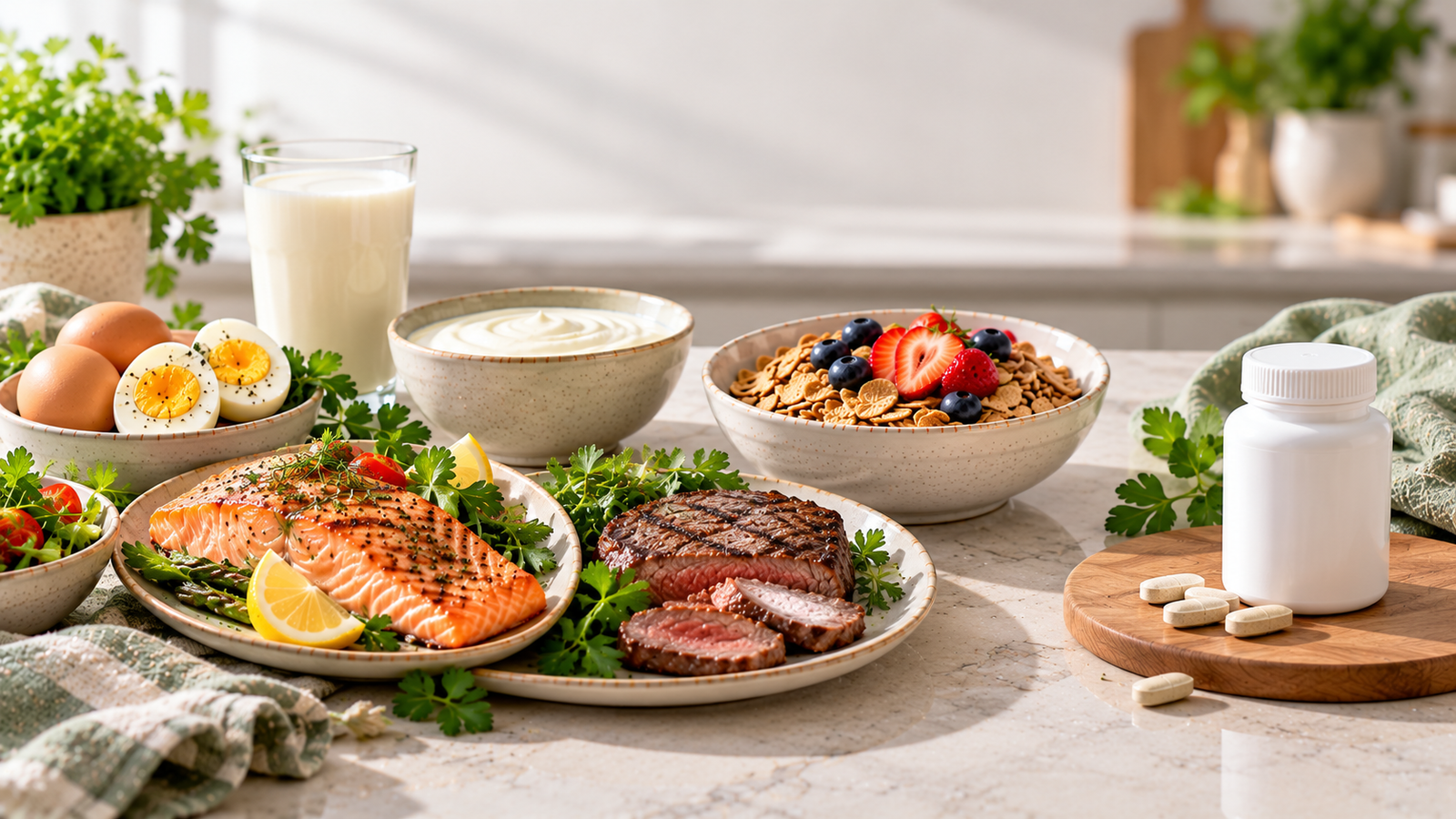
Natural and fortified vitamin B12 food sources, including fish, meat, eggs, milk, yogurt, cheese, and cereal.
Can You Get Enough Vitamin B12 From Food Alone?
Yes, many people can meet their vitamin B12 requirements through a varied diet that regularly includes reliable B12 sources.
For example, a person who eats fish, eggs, and dairy may obtain B12 from several meals throughout the day. You do not have to consume the entire daily requirement in one sitting.
However, food alone may not be enough for everyone.
People who may need additional planning
Vegans: Because unfortified plant foods are not dependable natural sources of B12, vegans need a reliable source from fortified foods, supplements, or both.
Older adults: Some older adults have reduced stomach acid, which can make it harder to release food-bound B12 for absorption. Some may still absorb crystalline B12 from fortified foods or supplements more effectively.
People with digestive conditions: Certain gastrointestinal conditions or surgeries can interfere with B12 absorption.
People taking certain medications: Long-term use of metformin and acid-reducing medicines may be associated with a higher risk of B12 deficiency in some people. Do not stop prescribed medication without speaking to your healthcare professional.
People with a diagnosed deficiency: Dietary improvements may help, but they may not correct a deficiency quickly or reliably enough on their own. Medical treatment may be necessary.
The important question is not simply whether you eat B12-rich foods. It is whether your intake and absorption are sufficient for your individual needs.
Vitamin B12 Supplements: What Are They, and How Do They Work?
Vitamin B12 supplements provide the nutrient in a concentrated form. They are available in several formulations, including tablets, capsules, liquids, and dissolvable products. Some are sold alone, while others combine B12 with additional vitamins or minerals.
Supplements can be useful when your diet does not provide enough B12 or when a healthcare professional recommends them to prevent or treat deficiency.
Common forms of vitamin B12 supplements
Two common forms are:
- Cyanocobalamin: A widely used, stable form of vitamin B12 found in many supplements and fortified products.
- Methylcobalamin: A form of B12 also used in supplements.
Other forms exist as well. Research has not established that methylcobalamin is generally superior to cyanocobalamin for routine supplementation in otherwise similar circumstances.
Choosing a supplement should focus on the amount, quality, suitability, and purpose of the product rather than marketing claims about one form being universally best.
What about B12 injections?
Vitamin B12 can also be given by injection. Injections may be recommended for certain deficiencies, particularly when absorption is impaired or when symptoms and clinical circumstances make this approach appropriate.
Not everyone needs injections. Some people can be treated effectively with oral supplements, including certain high-dose regimens. The choice depends on the cause and severity of the deficiency, symptoms, absorption, and local clinical guidance.
Are sublingual B12 supplements better?
Sublingual products dissolve under the tongue. Although they are marketed as a way to improve absorption, evidence has not established that they are generally more effective than standard oral B12 supplements for most people.
Follow product directions and ask a healthcare professional if you need treatment for a confirmed deficiency.
Vitamin B12 From Food vs Supplements: How Does Absorption Differ?
Vitamin B12 absorption is more complicated than simply swallowing or eating a particular amount.
How your body absorbs B12 from food
In most animal-derived foods, B12 is attached to proteins. During digestion, stomach acid and enzymes help release the vitamin from those proteins.
The released vitamin then binds to a protein called intrinsic factor, which is produced by cells in the stomach. The B12–intrinsic factor complex travels to the small intestine, where it can be absorbed.
Conditions that interfere with stomach function, intrinsic factor production, or the small intestine can reduce this process.
How your body absorbs B12 from supplements
B12 in supplements and fortified foods is generally present in a form that does not need to be released from food proteins first.
Most B12 absorption still depends on intrinsic factor, but a small percentage of a large oral dose can be absorbed by passive diffusion without it. This is one reason high-dose oral B12 can sometimes be used to treat deficiency even when normal absorption is impaired.
However, the fact that a high dose can be effective in some situations does not mean everyone needs one. Treatment decisions should account for the underlying cause and clinical circumstances.
Does more vitamin B12 mean better absorption?
Not necessarily. The proportion absorbed generally decreases as the oral dose increases, although the total amount absorbed can still rise.
For routine nutritional needs, the goal is to obtain enough B12 consistently. If a deficiency is suspected, a healthcare professional can assess whether a supplement, a particular dose, or injections are appropriate.
Vitamin B12 Daily Requirements: Food vs Supplements
The recommended daily intake depends on age and life stage. The following are US dietary recommendations.
| Age or life stage | Recommended daily intake |
|---|---|
| Children aged 1–3 | 0.9 mcg |
| Children aged 4–8 | 1.2 mcg |
| Children aged 9–13 | 1.8 mcg |
| Teenagers aged 14–18 | 2.4 mcg |
| Adults aged 19 and older | 2.4 mcg |
| Pregnant teenagers and adults | 2.6 mcg |
| Breastfeeding teenagers and adults | 2.8 mcg |
NIH Office of Dietary Supplements — Vitamin B12.
These values are recommended dietary allowances, not universal supplement doses. Official recommendations may differ by country.
Do you need a supplement containing only 2.4 mcg?
Not necessarily. The daily requirement describes how much B12 you need to obtain, not the amount that must appear on a supplement label.
Supplements may contain much larger amounts because only a fraction of a large oral dose is absorbed. Some high-dose products are intended for specific clinical situations, while other products are designed for routine supplementation.
If you already get enough B12 from food, a high-dose supplement may provide no additional benefit. If you have a deficiency or an absorption problem, a healthcare professional may recommend a dose higher than the standard dietary requirement.
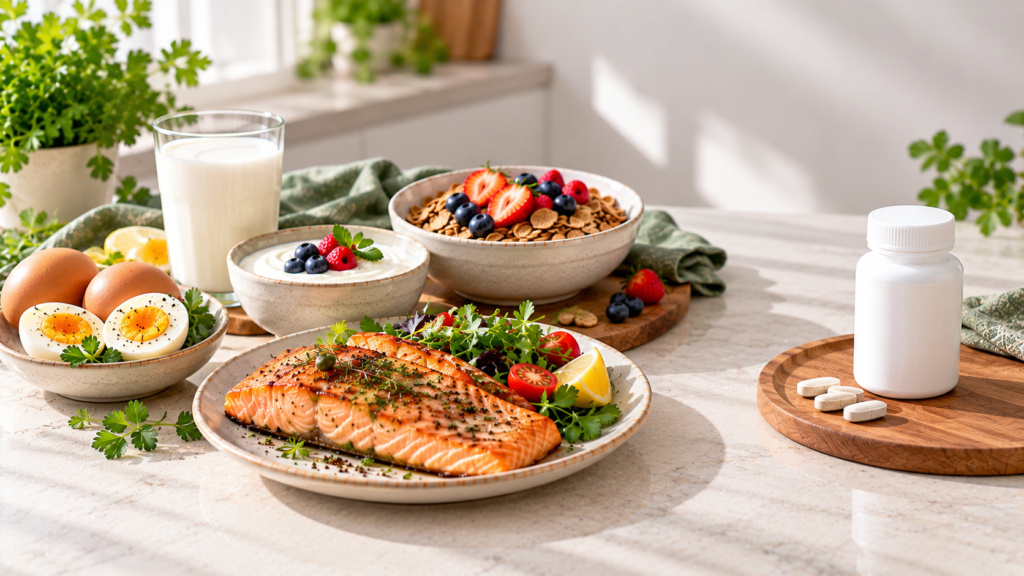
Vitamin B12 from food compared with supplements, showing fish, eggs, dairy, fortified cereal, and unbranded tablets.
Which Is Better: Vitamin B12 From Food or Supplements?
There is no single answer for everyone. The better option depends on your diet, nutritional status, and ability to absorb B12.
When food may be enough
Food may be sufficient if you regularly eat a varied diet that includes adequate amounts of B12-containing foods and have no significant absorption problems.
For example, fish, dairy, eggs, and certain other animal-derived foods can contribute B12 throughout the day. Fortified products can also help people who eat fewer animal-derived foods.
When supplements may be the better choice
Supplements may be useful if you:
- Follow a vegan diet and cannot reliably obtain enough B12 from fortified foods.
- Eat very little meat, fish, eggs, or dairy.
- Have a condition that affects B12 absorption.
- Have been diagnosed with vitamin B12 deficiency.
- Have been advised by a healthcare professional to supplement.
Can you combine food and supplements?
Yes. Food and supplements are not competing choices. Some people meet their needs through food, while others combine a varied diet with fortified products or supplements.
For instance, a vegan may consume fortified cereal and fortified plant-based milk while also taking a B12 supplement. A person with a diagnosed deficiency may continue eating B12-rich foods while following a prescribed treatment plan.
The goal is to ensure adequate intake and absorption, not to choose one source at the expense of all others.

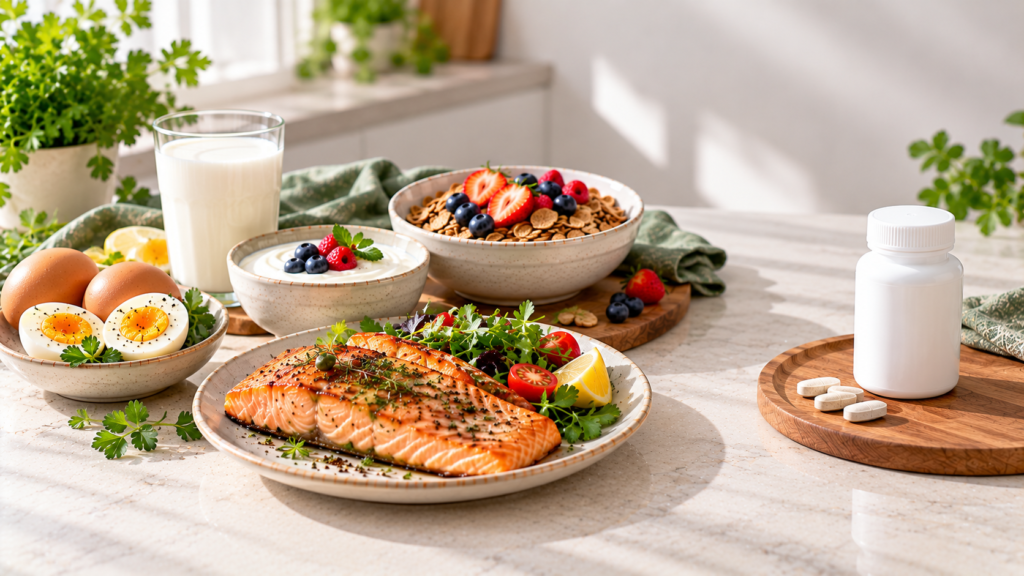
A balanced breakfast with vitamin B12-containing foods and a supplement bottle illustrating different ways to obtain B12.
Are Vitamin B12 Supplements Safe?
Vitamin B12 supplements are generally considered safe when used appropriately. No tolerable upper intake level has been established for vitamin B12 because it has a low potential for toxicity in healthy people.
However, this does not mean that everyone needs a high-dose product or that supplements should replace medical assessment.
Potential considerations
Unnecessary supplementation: If you already obtain enough B12 and absorb it normally, taking more is unlikely to provide extra benefits.
Product quality: Choose a reputable product with clearly stated ingredients and an appropriate dose.
Underlying deficiency: Taking a supplement without investigating the cause may delay the diagnosis of a condition that affects absorption.
Medication and health considerations: Discuss supplements with a healthcare professional if you take medication, have a chronic condition, or are treating a confirmed deficiency.
If you suspect a deficiency, do not rely on a supplement alone to determine whether your B12 status is improving. Testing and follow-up may be needed.
Signs You May Need More Vitamin B12
Vitamin B12 deficiency can develop gradually, and early symptoms may be vague. Possible signs include:
- Persistent tiredness or weakness
- Pale skin
- Shortness of breath associated with anemia
- A sore or smooth tongue
- Numbness or tingling in the hands or feet
- Difficulty with balance or walking
- Changes in concentration or memory
These symptoms can have other causes and do not confirm a B12 deficiency. A healthcare professional may assess your diet, medical history, symptoms, and blood tests to determine what is happening.
Can you correct a deficiency by eating more B12-rich foods?
Sometimes improving dietary intake is part of the solution, particularly when low intake is the cause. However, food alone may not be enough if your body cannot absorb B12 properly or if the deficiency is significant.
A confirmed deficiency may require oral supplements or injections, depending on the cause, severity, and clinical guidance.
Do not delay medical assessment if you experience persistent neurological symptoms such as numbness, tingling, or balance difficulties. Untreated B12 deficiency can cause serious complications.
NHS guide to vitamin B12 or folate deficiency anemia
Common Myths About Vitamin B12 From Food vs Supplements
Myth 1: Natural B12 from food is always better than supplemental B12
Fact: Both food and supplements can provide useful B12. The most appropriate source depends on your diet, absorption, and individual needs.
Myth 2: Everyone should take a high-dose B12 supplement
Fact: People who already meet their requirements may not benefit from additional B12. High-dose treatment may be appropriate for particular deficiencies or absorption problems, but it is not automatically necessary for everyone.
Myth 3: Plant foods naturally provide enough B12 for vegans
Fact: Most ordinary unfortified plant foods are not dependable sources of vitamin B12. Vegans should rely on verified fortified foods, suitable supplements, or both.
Myth 4: Vitamin B12 supplements always boost energy
Fact: B12 is essential for normal metabolism, but supplements do not generally improve energy in people who already have adequate levels.
Myth 5: If you eat B12-rich foods, you cannot become deficient
Fact: Some people have difficulty absorbing B12 even when their diet provides enough. Dietary intake is important, but it is not the only factor.
How to Decide Which Vitamin B12 Option Is Right for You
Use these practical steps to review your current routine.
- Review your diet. Identify whether you regularly eat fish, meat, eggs, dairy, or fortified foods.
- Check product labels. Confirm the amount of B12 in cereals, plant-based drinks, nutritional yeast, and other fortified products.
- Consider your dietary pattern. If you are vegan, plan a reliable source of B12 rather than assuming ordinary plant foods will provide it.
- Think about absorption. Certain digestive conditions, surgeries, and medications can affect B12 status.
- Recognize symptoms. If you have possible signs of deficiency, seek medical advice rather than trying to diagnose yourself through diet alone.
- Follow an appropriate plan. If supplementation is necessary, choose a suitable product and follow professional guidance when needed.
For general nutrition planning, a food diary and nutrition labels can help you estimate your intake. They cannot, however, establish whether you absorb B12 adequately or rule out a deficiency.
How Much Vitamin B12 Do You Need Per Day?
Vitamin B12 Deficiency: Signs, Causes and Food Sources.
Frequently Asked Questions
1. Is vitamin B12 from food better than supplements?
Neither is universally better. Food provides B12 alongside other nutrients, while supplements can provide a convenient and reliable source when dietary intake is insufficient or supplementation is medically indicated.
2. Can I get enough vitamin B12 from food without supplements?
Yes, many people can meet their needs through a varied diet containing sufficient B12-rich foods. Vegans and people with absorption problems may need fortified foods, supplements, or medical treatment.
3. Are vitamin B12 supplements absorbed better than food?
Absorption differs by source. Food-bound B12 must first be released from proteins during digestion, while B12 in supplements and fortified foods does not require that same step. Both generally use intrinsic factor for normal absorption, although a small amount of a large oral dose can be absorbed independently.
4. What is the best natural source of vitamin B12?
Certain shellfish, beef liver, and some other animal-derived foods are particularly rich sources. Salmon, other fish, meat, eggs, and dairy can also contribute. Exact amounts vary by food and serving size.
5. Should vegans take vitamin B12 supplements?
Vegans need a dependable source of B12 because ordinary unfortified plant foods are not reliable sources. Some meet their needs through carefully selected fortified foods, while others use supplements. The appropriate approach depends on the amount and consistency of intake.
6. Is a 1,000 mcg vitamin B12 supplement too much?
A 1,000 mcg dose is much higher than the adult daily dietary recommendation of 2.4 mcg, but high-dose products are sometimes used because only a fraction of a large oral dose is absorbed. Whether that dose is appropriate depends on why you are taking it and your individual circumstances.
7. Can vitamin B12 supplements help with tiredness?
They may help when tiredness is caused by B12 deficiency. If your B12 levels are already adequate, extra supplementation is not generally an effective energy booster. Persistent fatigue should be assessed because it has many possible causes.
8. Can I take vitamin B12 supplements and eat B12-rich foods together?
Yes. Eating B12-rich foods while taking a supplement is generally compatible. Some people use both to maintain adequate intake, while others require supplementation as part of deficiency treatment.
9. Do older adults need B12 supplements?
Not every older adult needs a supplement, but the risk of deficiency can increase with age because some people absorb food-bound B12 less effectively. Fortified foods, supplements, and medical assessment may be useful depending on the individual’s circumstances.
10. How do I know whether I need vitamin B12 supplements?
Review your diet and risk factors, and speak with a healthcare professional if you are uncertain or have symptoms. They may recommend blood tests and further assessment based on your medical history.
Conclusion: Choosing Between Vitamin B12 From Food vs Supplements
Understanding vitamin B12 from food vs supplements helps you make informed decisions about your nutritional health. Foods such as fish, meat, eggs, milk, and yogurt can provide B12 naturally, while fortified cereals and plant-based products offer additional options. Supplements can help fill dietary gaps and play an important role in preventing or treating deficiency.
For many people, a balanced diet that includes reliable B12 sources is sufficient. For vegans, people with restricted diets, older adults with absorption difficulties, and individuals with certain medical conditions, fortified foods or supplements may be essential.
The best approach is the one that reliably meets your needs. Check your food labels, consider your dietary pattern, and seek medical advice if you have symptoms or risk factors for deficiency. If a supplement is appropriate, use a suitable product rather than assuming that the highest dose is always the best choice.
Your next step: Review the B12 sources in your usual meals. If they are inconsistent or insufficient, explore verified fortified foods and discuss supplementation with a qualified healthcare professional when necessary.